
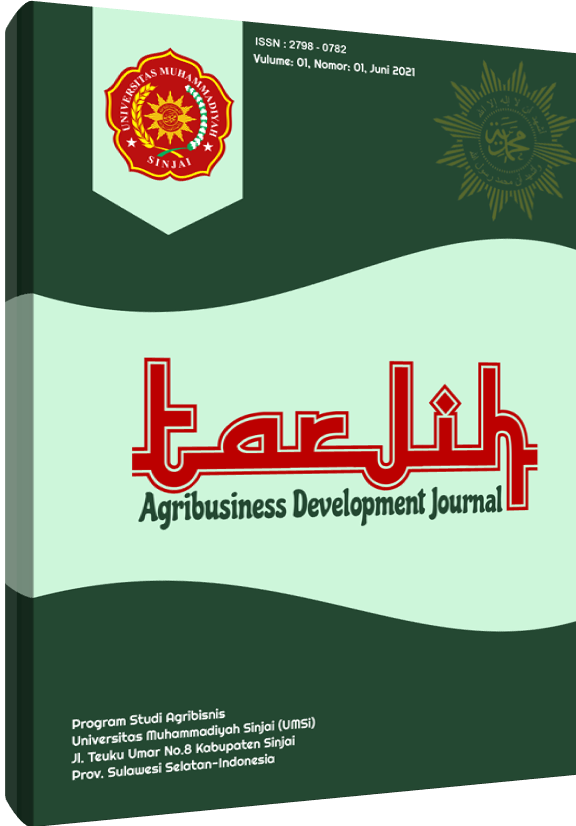
Determinants of Farm Income in Integrated Rice–Beef Cattle Farming Systems in Kahu District, Bone Regency
Article Sidebar
Integrated Farming,
Resource Allocation,
Rice–Beef Cattle System
Main Article Content
Abstract
Integrated rice–beef cattle farming systems are promoted as a sustainable agricultural strategy to improve resource-use efficiency and enhance farmers’ income through the integration of crop and livestock enterprises. However, empirical evidence regarding the determinants of farm income in integrated farming systems remains limited at the local level. This study aimed to analyze the effects of land area, production costs, and labor on farm income in integrated rice–beef cattle farming systems in Kahu District, Bone Regency. A quantitative cross-sectional survey was conducted from January to April 2025 involving 68 integrated farmers selected through simple random sampling. Data were analyzed using a log-linear multiple regression model estimated by Ordinary Least Squares (OLS). The results showed that land area had a positive and significant effect on farm income (β = 0.614; p < 0.001), while production costs (β = 0.115; p = 0.550) and labor (β = 0.048; p = 0.800) had positive but statistically insignificant effects. Simultaneously, all explanatory variables significantly affected farm income (F = 28.686; p < 0.001), with the model explaining 57.3% of the variation in farm income (R² = 0.573). These findings indicate that farm scale remains the dominant determinant of income in integrated farming systems. Policies supporting land optimization, integrated farming management, and resource-use efficiency are needed to strengthen the sustainability of smallholder farmers’ income.
Article Details

This work is licensed under a Creative Commons Attribution 4.0 International License.
References
Ambarwati, L., Dewi, T. R., & Solikah, U. N. (2022). Pengaruh modal, luas lahan, dan tenaga kerja terhadap pendapatan petani program IP Padi 400 di Kelompok Tani Sumber Harapan Kabupaten Sukoharjo. Jurnal Ilmiah Inovasi, 22. DOI: https://doi.org/10.25047/jii.v22i3.3558
Fyka, S. A., Rianse, U., Cahyani, D. N., & Limi, M. A. (2024). Comparative Analysis on the Income of Rice Farmers Who Apply an Integration and Conventional System. Jurnal Ilmiah Membangun Desa dan Pertanian, 9(1), 32-44. DOI: https://doi.org/10.37149/jimdp.v9i1.1023
Hikmah, A. N., Astaman, P., Hardianti, H., Zailan, A., Putri, H. A., Nurdin, F., ... & Raisa, D. M. (2024). A review of the sustainable paddy-cattle integrated farming system: enhancing climate resilience and agricultural productivity. Agriculture and Socio-Economic Journal, 1(3), 120-128. DOI: https://doi.org/10.61316/asej.v1i3.92
Kadir, M. J. (2020). Income analysis of integrated rice-cattle farming system in Tatae Village, Duampanua District, Pinrang Regency. Journal of Animal Science and Industry, 6(1), 42-56. DOI: https://doi.org/10.24252/jiip.v6i1.14448
Klau, M. I., Koehuan, J. E., Kette, A. U., Suratama, S. M., & Dethan, J. J. (2025). Determination of Production Factors on Paddy Productivity in Border Areas: An Empirical Study in Motaulun Village, West Malaka. Jurnal Pertanian Terpadu, 13(2), 179-190. DOI: 10.36084/jpt
Listiani, R., Setiadi, A., & Santoso, S. I. (2019). Analysis of farm income among rice farmers in Mlonggo District, Jepara Regency. Agrisocionomics Journal of Agricultural Socioeconomics,3(1), 50-58. DOI: https://doi.org/10.14710/agrisocionomics.v9i2.25210
Mahmud, H., Rauf, A., & Boekoesoe, Y. (2022). Production factors of paddy farming in Boliyohuto District, Gorontalo Regency. AGRINESIA Scientific Journal of Agribusiness,6(2), 96-102. DOl: 10.21275/23197064
Muyanga, M., & Jayne, T. S. (2019). Revisiting the farm size-productivity relationship based on a relatively wide range of farm sizes: Evidence from Kenya. American Journal of Agricultural Economics, 101(4), 1140-1163. DOI: https://doi.org/10.1093/ajae/aaz003
Mukhlis, M., Noer, M., Nofialdi, N., & Mahdi, M. (2019). Plagiarism Check: Analysis of Income and Feasibility of Rice-Cattle Integration System Farming Based on Enterprises Scale. https://doi.org/10.1039/d2fb00016d
Novitri, K., Edi, E., & Rita, Z. (2023). Comparative of generated income between integrated and non-integrated farming in Bengkulu Province, Indonesia. Russian Journal of Agricultural and Socio-Economic Sciences, 133(1), 96. DOI 10.18551/rjoas.2023-01.12
Novitri, K., & Ketut, S. (2020). Cost Efficiency Of Integrated Farming System Based On Rice-Cattle In Bengkulu Province Of Indonesia. Russian Journal of Agricultural and Socio-Economic Sciences, 107(11), 126-132. DOI https://doi.org/10.18551/rjoas.2020-11.15
Ren, C., Liu, S., Van Grinsven, H., Reis, S., Jin, S., Liu, H., & Gu, B. (2019). The impact of farm size on agricultural sustainability. Journal of Cleaner Production, 220, 357-367. DOI: https://doi.org/10.1016/j.jclepro.2019.02.151
Ricciardi, V., Mehrabi, Z., Wittman, H., James, D., & Ramankutty, N. (2021). Higher yields and more biodiversity on smaller farms. Nature Sustainability, 4(7), 651-657. DOI: https://doi.org/10.1038/s41893-021-00699-2
Shanmugam, P. M., Sangeetha, S. P., Prabu, P. C., Varshini, S. V., Renukadevi, A., Ravisankar, N., ... & Gopi, M. (2024). Crop–livestock-integrated farming system A strategy to achieve synergy between agricultural production. DOI: 10.3389/fsufs.2024.1338299
Thaal, A., Taena, W., & Joka, U. (2022). Economic Feasibility of Integrated Agriculture Pattern for Bali Cattle (Bos Javanicus) in North Central Timor Regency. Agriecobis Journal of Agricultural Socioeconomics and Business. DOI: https://doi.org/10.22219/agriecobis.v5i02.17783
Zailan, A. (2022). Analisis Produksi Dan Pendapatan Usahatani Terintegrasi Padi–Ternak Sapi Potong DI Kecamatan Kahu Kabupaten Bone. AgriMu. DOI: https://doi.org/10.26618/agm.v2i2.7689